What are the key components of an insulating glass production line? This question matters because every station influences air tightness, thermal performance, and service life. A clean production floor may look simple, yet small defects can remain hidden inside a sealed glass unit.
Dr. Stephen Selkowitz, a respected building-performance expert, has emphasized, “High-performance windows are a critical part of the building energy equation.” His view connects factory discipline with real building results. The window is not merely glass in a frame. It is a carefully controlled system.
This guide examines seven essential components of an insulating glass production line. They include the glass loading section, automatic washing machine, spacer-frame assembly station, glass pressing unit, gas-filling system, secondary sealant applicator, and final inspection controls. Each component has a specific job. Each also depends on the previous one.
A washer with poor filtration can leave invisible particles on the glass. A misaligned spacer can reduce the cavity width. Incomplete sealant coverage can permit moisture entry years later. These are practical risks, not theoretical concerns.
Experienced manufacturers usually monitor glass cleanliness, spacer position, sealant depth, gas concentration, and production speed. Still, no line is perfect. Operators can miss unusual defects, especially during rushed shifts. That weakness deserves honest attention.
The following sections explain how the seven components work together, where quality problems commonly appear, and which details deserve closer inspection before choosing equipment.
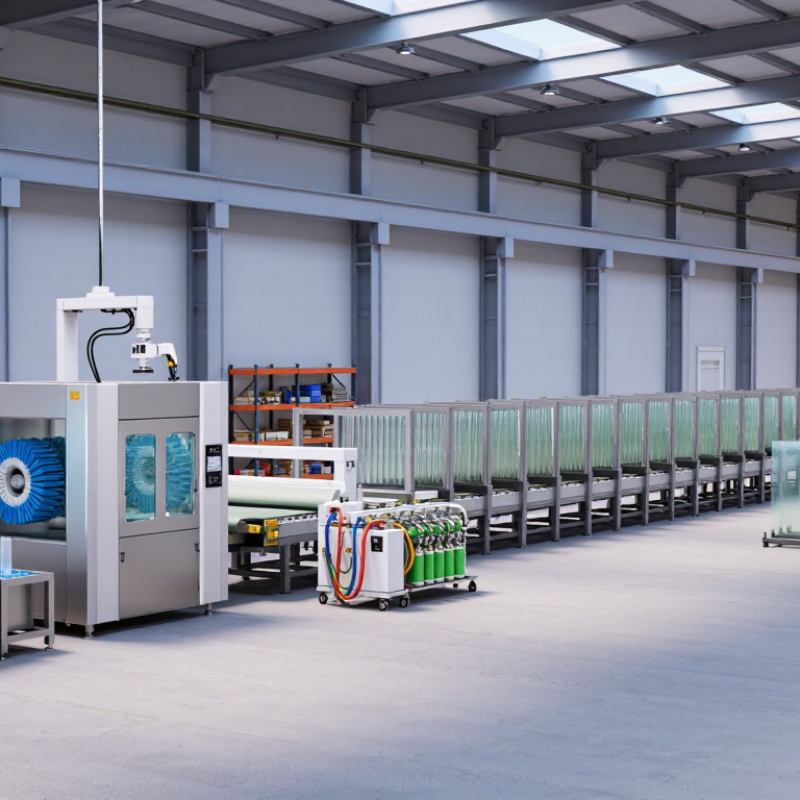
Insulating glass production lines create sealed units that reduce heat transfer and outside noise. Their purpose is simple: keep two glass panes apart with a dry, stable airspace. A typical structure includes a loading table, washing machine, positioning section, spacer applicator, gas-filling press, sealing unit, and inspection conveyor. Each component affects edge quality, alignment, and long-term durability.
The workflow begins when operators place cut glass on the loading table. Rollers move each pane through brushes and filtered water. Clean surfaces matter because tiny particles can weaken the seal. The positioning section aligns the panes with millimeter-level control. Then, a spacer frame containing desiccant is applied between them. Some lines bend the spacer automatically, while others use pre-formed frames. The press joins the panes and may fill the cavity with inert gas. Gas loss can occur if timing or sealing pressure is poorly controlled.
A secondary sealant is applied around the edges to block moisture. The final conveyor checks dimensions, scratches, corner contact, and visible contamination. Experienced technicians also inspect the first units from every production batch. Machines improve consistency, but they do not replace judgment. Even a well-designed line can produce weak units when glass temperature, sealant curing, or spacer placement is ignored. That is where process records and regular calibration become practical tools, not paperwork.
Glass cutting and edge processing units determine how accurately an insulating glass production line prepares each panel. Cutting tables should follow digital measurements closely, while edge-deletion units remove coating from the sealing zone. Even a narrow untreated strip can affect adhesion and gas retention. This detail is easy to underestimate.
The U.S. Department of Energy reports that windows can account for 25–30% of residential heating and cooling energy use. Therefore, clean edges and accurate dimensions are not cosmetic concerns. They influence the insulating unit’s long-term performance. The International Energy Agency also identifies building efficiency as a major route for reducing energy demand. Precise glass preparation supports that objective.
In daily production, automatic measurement systems reduce manual reading errors. Conveyor alignment matters just as much. A small offset may create uneven spacer contact or visible pressure marks. Edge-seaming wheels must be adjusted for glass thickness, coating position, and required seal width. Operators should inspect corners under strong, angled light. Some defects appear only after washing. That is a practical weakness in many lines.
Published fenestration testing guidance emphasizes repeatable dimensions, edge quality, and durable sealing. Yet no machine removes the need for process checks. Cutting speed, blade condition, and glass temperature can change results. A well-designed line records these variables for every batch. That record supports traceability and honest troubleshooting when performance falls short.
Indicative cycle-time benchmarks for precise panel preparation and insulating glass unit assembly.
The chart shows representative processing time per lite or unit in a medium-volume production line. Actual cycle times vary with glass size, thickness, automation level, spacer design, sealant type, and line layout.
The spacer assembly system shapes the insulating glass unit’s cavity. It must maintain consistent width, clean corners, and accurate alignment. A small gap can create uneven thermal performance. The U.S. Department of Energy reports that windows may account for 25–30% of residential heating and cooling energy use. This makes cavity quality more than a production detail.
Desiccant filling is equally important. Molecular sieve must be distributed evenly inside the spacer, without dust entering the sealant area. Overfilling wastes material. Underfilling raises the risk of internal condensation. EN 1279 testing evaluates insulating glass durability, including moisture resistance and gas retention. Production lines should therefore monitor dosage weight, filling speed, and spacer cleanliness. Simple checks help.
In production audits, operators often discover that the filling station is not the main problem. Poorly stored desiccant may already have absorbed moisture. Open containers, humid air, and long delays can reduce performance before assembly begins. A covered hopper, controlled storage area, and automatic weighing system provide practical protection. Yet no system is perfect. Sensors drift, corners remain difficult, and manual inspection still matters. The International Energy Agency reported that buildings consumed about 30% of global final energy in 2022, reinforcing the value of reliable envelope components. The cavity deserves careful attention.
In an insulating glass production line, sealing equipment protects the unit’s weakest edge: the spacer-to-glass joint. Reliable machinery applies primary and secondary sealants with controlled pressure, temperature, and speed. The operator watches bead width on the monitor and checks the first panel by hand. Small gaps matter. They can invite moisture and reduce thermal performance.
Quality checks should include bead depth, corner coverage, adhesion, and sealant cure. Record batch numbers and machine settings for traceability. A practical test uses sample units, warm storage, and visual inspection after stressing the edges. Not every defect appears immediately. Operators should pause the line when pressure fluctuates, even if the panel looks acceptable. Automation reduces variation, but it does not replace judgment. Teams should review failed samples openly and adjust maintenance intervals when evidence supports it.
An insulating glass production line needs seven practical components: spacer preparation, frame assembly, desiccant filling, gas filling, pressing, inspection, and final handling. Gas filling deserves special attention. Argon is commonly used because it lowers heat transfer between panes. Many production systems target more than 90% initial argon concentration, although the exact requirement depends on the specification and local standard. Small leaks can erase the expected thermal benefit.
Pressing equipment must apply even force across the glass surface. Uneven pressure may create edge gaps, roller marks, or visible distortion. Inspection should combine camera checks, thickness measurement, sealant monitoring, and gas analysis.
Standards such as EN 1279 examine gas concentration, moisture resistance, and long-term durability. A line that passes visual inspection can still produce weak units. That is an uncomfortable fact.
Final handling is not a minor step. Soft supports, clean transfer tables, and controlled stacking reduce scratches and edge damage. The U.S. Department of Energy reports that low-emissivity glazing can reduce window energy loss by roughly 30% to 50% compared with clear glazing. UNEP’s 2023 Global Status Report states that buildings consume about 30% of global final energy. These figures make process control commercially important, not merely technical.
In practice, operators should record gas purity, pressing pressure, sealant temperature, and inspection results for every batch. Manual checks still matter. Machines miss context.
They include spacer preparation, frame assembly, desiccant filling, gas filling, pressing, inspection, and final handling.
It creates the cavity between glass panes. Consistent width improves alignment and thermal performance. Small gaps can cause uneven results.
Fill the spacer evenly and keep dust away from the sealant area. Monitor weight and filling speed. Overfilling wastes material.
Open containers and humid air can make desiccant absorb moisture early. Use covered hoppers and controlled storage. Storage is easy to overlook.
Argon can reduce heat transfer between panes. Many systems target over 90% initial concentration. The exact target depends on specifications and local requirements.
Uneven pressure may cause edge gaps, roller marks, or glass distortion. Pressure should remain balanced across the surface. Machines can still drift.
Use camera checks, thickness measurements, sealant monitoring, and gas analysis. Visual inspection alone may miss weak units. That is uncomfortable.
Use soft supports, clean transfer tables, and controlled stacking. These steps reduce scratches and edge damage. Small marks still matter.
Record gas purity, pressing pressure, sealant temperature, and inspection results for every batch. Manual checks remain useful. Machines miss context.
An insulating glass production line is a coordinated system designed to manufacture energy-efficient glass units with a sealed cavity between two or more panes. What are the key components of an insulating glass production line? The main sections typically include glass cutting and edge-processing units, which prepare panels with accurate dimensions and clean, smooth edges for reliable assembly. Spacer assembly and desiccant-filling systems then create the cavity framework, help control moisture, and support consistent thermal performance.
Sealing equipment applies primary and secondary sealants to protect the unit from air and moisture penetration. Gas-filling systems may introduce an insulating gas into the cavity, while pressing equipment joins the glass and spacer firmly into a stable structure. Finally, inspection stations check dimensions, cleanliness, sealing quality, and visual appearance before the finished units are transferred for handling, storage, or installation. Together, these components create an efficient workflow that improves production accuracy, durability, and overall insulating performance.

Yabo CNC